
What is an Ectopic Pregnancy and How is it Treated?

By Nathalia Comrie - July 28, 2026
An ectopic pregnancy occurs when an embryo implants and begins to grow outside the uterus.
Only the uterus can safely support a growing embryo, so when implantation happens elsewhere, it is very risky. An ectopic pregnancy cannot develop normally and needs medical attention. If not treated, the embryo may keep growing until the fallopian tube bursts, which can cause dangerous internal bleeding and become life-threatening.[1]
How common is it?
In Canada, 1-2% of diagnosed pregnancies are ectopic, and about 4% of maternal deaths are caused by untreated ectopic pregnancies.[2] If you have symptoms of an ectopic pregnancy, it is important to get medical help.
What are the Causes?
About 95% of ectopic pregnancies happen in the fallopian tubes.[3] Less often, the embryo implants in the uterine muscle (1–2%), abdominal cavity (1–2%), ovaries (less than 1%), or cervix (less than 1%).[4]
The fallopian tubes are narrow tubes that move a mature egg from the ovaries to the uterus. Each tube is about 10 cm long and 0.5 cm wide, and they sit on either side of the uterus, connecting through small openings. Usually, fertilization happens in the fallopian tube, and then the new embryo travels to the uterus to implant.[5] The tubes only transport the embryo; they are not meant for implantation.[6] Several risk factors can make a pregnancy ectopic, including:
Pelvic inflammatory disease
Smoking
Family history of ectopic pregnancies
Previous fallopian tube surgery
Fallopian tube abnormalities [7]
Problems with the fallopian tubes can lead to ectopic pregnancies. These problems may be caused by past sexually transmitted infections, surgeries on the tubes, or exposure to diethylstilbestrol (a synthetic estrogen hormone)[8] in the uterus.
Hormonal birth control methods like IUDs and progesterone-only contraceptives are also risk factors.[9] Synthetic progestins can lower the number and movement of cilia, which are tiny hair-like structures in the fallopian tubes that help move eggs and embryos. When cilia do not work well, the embryo may get delayed or stuck in the tube, raising the risk of it implanting there instead of in the uterus.[10]
Symptoms
Symptoms of an ectopic pregnancy usually appear early on.[11] If you notice any of these signs, it is important to see a doctor:
Lower abdominal pain
Pelvic Pain
Vaginal bleeding
Signs of a ruptured fallopian tube: Dizziness, Fainting, Shoulder pain, Severe pelvic pain
Treatment
There are several treatments for ectopic pregnancy. These include surgery, medication, and expectant management.
Expectant Management
Expectant management means letting the ectopic pregnancy end on its own, without medical intervention.[12] During this time, patients are watched closely, often in a hospital.
With this approach, patients usually have two blood tests in the first week, then one each week after, until hCG levels drop below 5 mIU/mL. HCG, or human chorionic gonadotropin, is a hormone made after conception.[13] Pregnancy tests detect hCG to see if a woman is pregnant. If hCG is below 5 milli-international units per milliliter, it means there is no pregnancy. This treatment works for about 4 out of 10 patients.
Expectant management is generally available when:
hCG levels are low
There are no health concerns with the patient.
Little to no pain is experienced
The embryo is small
There is no bleeding in the abdomen.
In these situations, the body usually absorbs the embryo naturally, ending the pregnancy.[14] Doctors prefer this method because it is the least invasive and allows for the fastest recovery.
Risks
There are some risks associated with expectant management. One of them is that the ectopic pregnancy cells continue to grow. This could lead to the need for further medical intervention. 29% of women who begin with expectant management may require further medical intervention. A doctor will determine if other treatments are required by monitoring hCG levels.[15] If hCG levels are increasing, it means the embryo is still growing, which puts the fallopian tube at risk of rupture.
Methotrexate
With this treatment, the patient gets an injection of methotrexate. This drug is often used for cancer because it targets fast-growing cells. In ectopic pregnancy, methotrexate stops the embryo's cells from dividing by blocking folic acid in the body.[16] The body absorbs the embryo within 4-6 weeks.[17] Blood tests are done until hCG is gone. If hCG does not drop after the first dose, a second dose may be given. This method is considered a type of abortion because it directly ends the embryo's development.
Risks:
With this treatment, patients need regular check-ups with their doctor because there is still a risk of the fallopian tube bursting and internal bleeding until the pregnancy is completely over.
Side effects of Methotrexate:[18]
Mouth sores
Diarrhea
Signs of anemia (such as unusual tiredness, pale skin)
Signs of liver problems (such as nausea/vomiting that doesn't stop, dark urine, Stomach/abdominal pain, yellowing eyes/skin)
Easy bruising/bleeding
Black stools
Unusual pain and discoloration of the skin
Signs of kidney problems (such as change in the amount of urine)
Get medical help right away if you have any very serious side effects, including:
Irregular heartbeat
Vision changes
Weakness on one side of the body
Severe headache
Neck stiffness
Mental/mood changes
Seizures
Salpingostomy
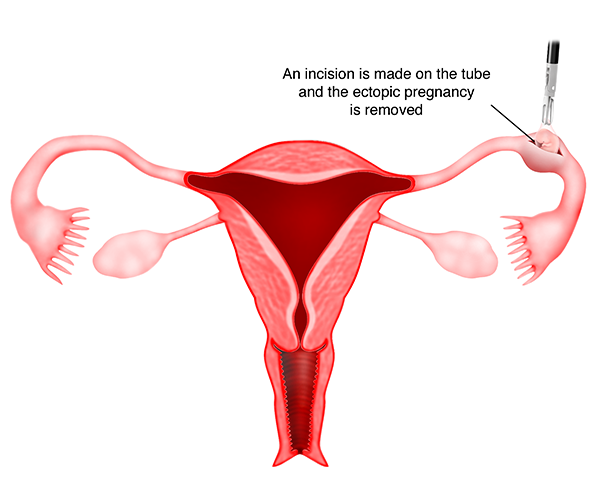
A salpingostomy is a surgery to treat an ectopic pregnancy. It can be done as open surgery (laparotomy) or with minimally invasive surgery (laparoscopy), using general or regional anesthesia. The surgeon makes a small cut in the fallopian tube to remove the embryo but tries to keep the tube intact. After removing the embryo and pregnancy tissue, the tube is closed with stitches or surgical glue, leaving only small scars. If the tube has already ruptured, it may need to be removed in a procedure called a salpingectomy.[19]
Salpingectomy
A salpingectomy is a surgery where part or all of the fallopian tube is removed along with the embryo. There are two ways to do this procedure:
Laparoscopic salpingectomy: This is a minimally invasive surgery using a thin tube with a light and camera called a laparoscope. The surgeon makes a few small cuts in the abdomen and uses special tools to remove the affected fallopian tube. The cuts are closed with stitches or surgical glue, leaving only small scars. This method usually takes about an hour or less.
Open abdominal salpingectomy: This surgery is done through a larger cut in the abdomen, called a laparotomy. It gives the surgeon direct access to the fallopian tubes to remove the affected tube. The cut is closed with stitches or staples.[20]
If a woman still has one healthy fallopian tube, her chances of getting pregnant in the future are about the same whether she has a salpingostomy or a salpingectomy. Fertility is usually not affected, and future pregnancy is still possible with the remaining tube.
In two rare cases, doctors were able to move an embryo from the fallopian tube to the uterus, and the pregnancy continued safely. This was done by performing a laparotomy with a salpingostomy, then making a hole in the uterus and transferring the embryo inside. However, there is currently no standard medical procedure to remove an embryo from the fallopian tube and reimplant it in the uterus.[21]
Abortion is not medically necessary to save the life of the patient with an ectopic pregnancy. There are alternative options available. Contact us to discuss your options.
[1] Mayo Clinic Staff, “Ectopic Pregnancy: Symptoms & Causes,” Mayo Clinic, March 12, 2022,https://www.mayoclinic.org/diseases-conditions/ectopi-pregnancy/symptoms-causes/syc-20372088.
[2] Heather Murray, Hanadi Baakdah, Trevor Bardell, and Togas Tulandi, “Diagnosis and Treatment of Ectopic Pregnancy,” Canadian Medical Association Journal 173, no. 8 (2005): 905–912, https://doi.org/10.1503/cmaj.050222
[3] Elsa S. Vadakekut and David M. Gnugnoli, “Ectopic Pregnancy,” in StatPearls [Internet] (Treasure Island, FL: StatPearls Publishing, updated March 27, 2025),https://www.ncbi.nlm.nih.gov/books/NBK539860/.
[4] Sherk, Stephanie Dionne. “Salpingostomy.” Gale Encyclopedia of Surgery: A Guide for Patients and Caregivers. Surgery Encyclopedia. Accessed July 28, 2026.https://www.surgeryencyclopedia.com/Pa-St/Salpingostomy.html.
[5] Sherk, Stephanie Dionne. “Salpingostomy.” Gale Encyclopedia of Surgery: A Guide for Patients and Caregivers. Surgery Encyclopedia. Accessed July 28, 2026.https://www.surgeryencyclopedia.com/Pa-St/Salpingostomy.html.
[6] Cleveland Clinic, “Fallopian Tubes: Uterine, Location, Anatomy & Function,” Cleveland Clinic, last updated May 7, 2026,https://my.clevelandclinic.org/health/body/23184-fallopian-tubes.
[7] Elsa S. Vadakekut and David M. Gnugnoli, “Ectopic Pregnancy,” in StatPearls [Internet] (Treasure Island, FL: StatPearls Publishing, last updated March 27, 2025),https://www.ncbi.nlm.nih.gov/books/NBK539860/.
[8] International Agency for Research on the Evaluation of Carcinogenic Risks to Humans, “Diethylstilbestrol,” in Pharmaceuticals, IARC Monographs on the Evaluation of Carcinogenic Risks to Humans, no. 100A (Lyon, France: International Agency for Research on Cancer, 2012),https://www.ncbi.nlm.nih.gov/books/NBK304340/.
[9] Elsa S. Vadakekut and David M. Gnugnoli, “Ectopic Pregnancy,” in StatPearls [Internet] (Treasure Island, FL: StatPearls Publishing, last updated March 27, 2025),https://www.ncbi.nlm.nih.gov/books/NBK539860/.
[10] Vanitha N. Sivalingam, Mary J. Duncan, John A. Kirk, Hany Shephard, and Andrew W. Horne, “Diagnosis and Management of Ectopic Pregnancy,” Journal of Family Planning and Reproductive Health Care 37, no. 4 (2011): 231–240, https://doi.org/10.1136/jfprhc-2011-0073.
[11] Vadakekut, Elsa S., and David M. Gnugnoli. 2025. "Ectopic Pregnancy." In StatPearls [Internet]. Treasure Island, FL: StatPearls Publishing. Updated March 27, 2025. Accessed July 24, 2026.https://www.ncbi.nlm.nih.gov/books/NBK539860/.
[12] Manchester University NHS Foundation Trust. Expectant Management of Ectopic Pregnancy. Patient Information Leaflet SMPIL-24-014. Updated April 2026. Accessed July 24, 2026.https://mft.nhs.uk/app/uploads/sites/4/2025/12/SMPIL-24-014-Expectant-management-of-ectopic-pregnancy.pdf.
[13] The Ectopic Pregnancy Trust. 2026. “Expectant Management.” Last reviewed March 9, 2026. Accessed July 24, 2026.https://ectopic.org.uk/treating-an-ectopic-pregnancy/expectant-management.
[14] NHS. 2022. “Treatment – Ectopic Pregnancy.” Last reviewed August 23, 2022. Accessed July 24, 2026.https://www.nhs.uk/conditions/ectopic-pregnancy/treatment/.
[15] Manchester University NHS Foundation Trust. 2026. Expectant Management of Ectopic Pregnancy. Patient Information Leaflet SMPIL-24-014. Updated April 2026. Accessed July 24, 2026.https://mft.nhs.uk/app/uploads/sites/4/2025/12/SMPIL-24-014-Expectant-management-of-ectopic-pregnancy.pdf.
[16] University of Iowa Health Care. 2023. Methotrexate for Ectopic Pregnancy. Patient Education. Last reviewed August 2023. Accessed July 24, 2026.https://uihc.org/educational-resources/methotrexate-ectopic-pregnancy.
[17] American College of Obstetricians and Gynecologists. 2026. “Ectopic Pregnancy.” Frequently Asked Questions. Last reviewed April 2026. Accessed July 24, 2026.https://www.acog.org/womens-health/faqs/ectopic-pregnancy.
[18] MyHealth Alberta. 2026. Methotrexate – Injection. Last revised March 2026. Accessed July 24, 2026.https://myhealth.alberta.ca/Health/medications/Pages/conditions.aspx?hwid=fdb4133.
[19] Vadakekut, Elsa S., and David M. Gnugnoli. “Ectopic Pregnancy.” In StatPearls. Treasure Island, FL: StatPearls Publishing, 2026. Last updated March 27, 2025.NCBI Bookshelf.
[20] Cleveland Clinic. 2024. “Salpingectomy: Purpose, Procedure, Risks & Recovery.” Last reviewed May 24, 2024. Accessed July 24, 2026.https://my.clevelandclinic.org/hesuturedalth/treatments/21879-salpingectomy.
[21] M. J. Hill, K. M. Cottrell, and S. R. Gunn, “Diagnosis and Management of Ectopic Pregnancy,” BMJ 381 (2023): e070672, https://doi.org/10.1136/bmj-2022-070672